
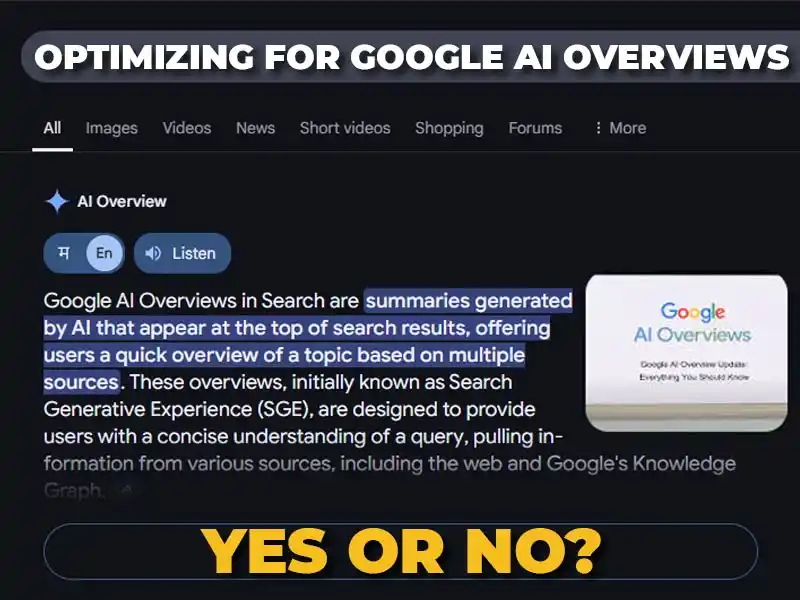
In May 2024, Google dropped a seismic update that’s changing the way we interact with search results: Google AI Overviews. While still rolling out gradually, these AI-generated summaries are already taking up prime real estate on search engine results pages (SERPs) and if you’re a digital marketer, it’s time to pay attention.
Should you optimize your content for these AI Overviews? Will it drive more traffic to your site or take it away? Is this the next evolution of SEO, or just hype?
What Are Google AI Overviews?
Google AI Overviews, formerly known as Search Generative Experience or SGE, are AI-generated answers that appear at the top of certain search results. Instead of just showing a list of blue links, Google now provides an AI-written summary that pulls data from various online sources to answer the user’s query directly.
For example, instead of showing you ten links for “how to write a blog post,” Google might display a detailed, AI-written answer, above the fold, summarizing tips and strategies, with links to the sources at the bottom of the overview.
These Overviews are powered by Google’s Gemini AI and designed to help users “get up to speed” faster, but they may also mean fewer clicks to individual websites.
Why This Matters for Marketers
You already know how competitive ranking on Google is. With AI Overviews:
- Your hard-earned featured snippets might be displaced.
- Your content could be used in the overview, but without a guaranteed click.
- Or worse: You might not be referenced at all.
So, what does this mean for SEO strategy? Do we adapt and optimize for this new format? Or focus elsewhere?
The Pros of Optimizing for Google AI Overviews
1. Increased Visibility (Even Without the Click)
Even if users don’t always click through to your site, being referenced in a Google AI Overview still increases brand visibility. It is the new “position zero.”
Your brand, company, or article may be quoted, summarized, or cited directly in the AI content, a major credibility boost in competitive niches.
For a digital marketing agency like PaperCraft, appearing in these summaries helps position us as a thought leader in the SEO and content space.
2. Early Adopters Win More Often
Just like the early days of featured snippets and voice search, those who adapted early gained an edge. Optimizing for AI Overviews now means you can stake your claim in a less saturated field.
It is digital land-grabbing, the first movers get the visibility, and the algorithm starts to trust those sources.
3. Google’s Still Linking to Sources (For Now)
While Overviews reduce the need to click, Google still includes source links at the bottom of each AI-generated summary. These can drive qualified, intent-driven traffic from users looking for deeper insight.
That’s where well-written, authoritative content still plays a role, especially when it’s structured clearly and written with expertise.
4. E-E-A-T Still Matters
Google’s algorithm still relies on the principles of Experience, Expertise, Authoritativeness, and Trustworthiness (E-E-A-T) when evaluating content, and this likely informs which sources are included in AI Overviews.
By building content that demonstrates these qualities, you boost your odds of being selected by the AI model.
The Risks and Challenges of Optimizing for AI Overviews
1. Zero-Click Searches Are Rising
The more Google answers inside its platform, the fewer reasons users have to leave it.
Many marketers report a decline in CTR (click-through rate) even when their content is cited in an Google AI Overview. Google essentially “scrapes” your answer and gives it away upfront.
So while visibility might increase, traffic may decline.
2. Lack of Control Over Summaries
AI doesn’t always get it right. It may take content out of context or summarize things inaccurately. If your brand is misrepresented or if outdated content is quoted, the user experience could suffer.
And unlike featured snippets, you don’t get a dedicated box. You’re one of several citations, often buried at the bottom.
3. No Clear Way to Measure Impact (Yet)
As of now, there’s no dedicated analytics for tracking how your content is performing in AI Overviews. Google Search Console doesn’t break it out, and you can’t optimize for it as precisely as you can for featured snippets or rich results.
For data-driven marketers, this lack of visibility is frustrating.
So… Should You Optimize for Google AI Overviews?
The short answer is yes, you should go for Generative Engine Optimization, but cautiously and strategically.
It is a brand awareness advertising. You may not see immediate ROI in traffic or conversions, but showing up in Google AI Overviews helps reinforce your expertise, boost credibility, and maintain visibility at the top of the funnel.
As more users rely on AI for answers, not showing up may mean losing ground to competitors.
Here’s how to do it right.
How to Optimize Your Content for Google AI Overviews
1. Structure Content Clearly
- Use H2s and H3s to break down answers.
- Include summaries, FAQs, bullet points, and numbered lists.
- Use clear, concise language. Aim for clarity, not complexity.
2. Focus on Topical Authority
- Cover your niche comprehensively.
- Link related content together to build thematic clusters.
- Create deep, well-researched articles that go beyond surface-level SEO.
3. Include Factual, Sourceable Information
- Use statistics, data, and citations from trusted sources.
- The AI model often pulls from content that is factual, data-driven, and answers questions directly.
4. Refresh Old Content
- Keep your content up-to-date to stay eligible for Google AI Overviews.
- Update headers, stats, and publishing dates where necessary.
5. Implement Schema Markup
Structured data like FAQPage, HowTo, and Article schema helps Google parse your content more easily and could improve your inclusion chances.
What This Means for the Future of SEO
Search is evolving again. And as with every update, some marketers will resist the change and fall behind, while others will adapt and thrive.
Google AI Overviews are not the death of SEO, but they are the start of a new SEO era, where content needs to be more helpful, more structured, and more trustworthy than ever.
How PaperCraft Helps You Stay Ahead
At PaperCraft, we’ve been tracking the rise of AI in search since day one.
We help brands:
- Craft content that’s optimized for humans and AI alike.
- Build authority in their niche to qualify for AI Overviews and featured spots.
- Create SEO strategies that adapt with Google’s constant evolution.
Whether you’re a startup trying to grow or an enterprise brand defending your rankings, we’ll guide you through the AI search wave with clear strategy, measurable results, and a content team that gets it.
Final Verdict
The Google AI Overview update isn’t something marketers can afford to ignore. But it’s not about chasing the next shiny object, it’s about adapting to a smarter search ecosystem.
So yes, optimize. Not for vanity clicks or outdated keyword stuffing, but for relevance, clarity, and trust.
And if you want to lead, AI-powered future of search, we’re here to help.
Reach out to PaperCraft now and let’s build your AI-ready content strategy together.