
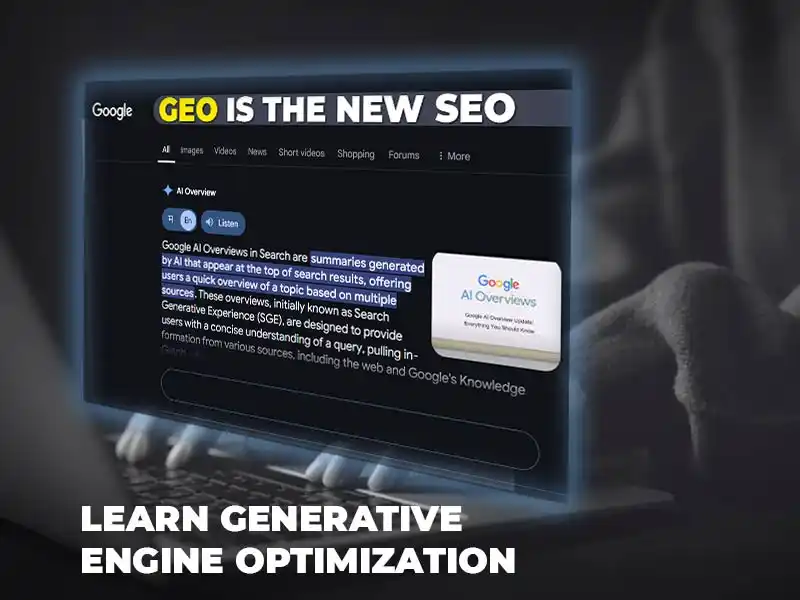
SEO Enters a New Era
Remember when SEO was all about keywords, backlinks, and meta descriptions? In 2025, the landscape looks entirely different. Users no longer search in the same linear fashion thanks to the emergence of AI-powered platforms like ChatGPT and Gemini. Instead, they’re interacting with generative engines tools that provide instant, conversational responses instead of just a list of links.
A new field known as Generative Engine Optimization (GEO) has emerged as a result of this fundamental change. Businesses now need to reconsider how they organise information to match AI-generated responses, even though traditional SEO is still important. If you’re wondering how to stay ahead in this rapidly evolving space, this blog will guide you through what GEO means, how to optimize for AI search, and what Gemini and ChatGPT are examples of SEO tactics that are future-proof.
1. What Is Generative Engine Optimization?
It refers to the practice of tailoring your content to better align with the needs and mechanics of AI-driven search interfaces. Generative engines summarise, analyse, and even reinterpret your material in real-time, in contrast to traditional search engines that give preference to static webpages.
Key characteristics of GEO:
- Focus on semantic depth and contextual relevance rather than just keywords.
- Content must be structured clearly to be easily parsed and summarised by AI.
- Increasing importance of authoritativeness and credibility, as AI models prefer high-quality sources.
- Integration with natural language queries, which AI engines understand better than keyword-stuffed content.
2. GEO vs SEO: What’s the Difference?
| Aspect | Traditional SEO | GEO |
| Focus | Keywords, backlinks, meta data | Semantic depth, clarity, authority |
| Output | Ranked web pages | Conversational, AI-generated responses |
| Optimised for | Google SERPs | Chat-based engines (ChatGPT, Gemini) |
| Key Metrics | CTR, bounce rate, backlinks | Content coverage, accuracy, entity linking |
| Behaviour | Click-through links | Direct answers within AI platforms |
As you can see, GEO requires a shift in mindset. Being the source of the AI’s response is more important than ranking #1 on Google.
3. Tips for 2025 AI Search Optimisation
If you’re aiming to future-proof your content, it’s essential to understand how generative engines process and prioritise information. Here’s how to successfully optimize for AI search:
a. Emphasise Structured and Clear Content
- Content should be divided into logical sections using subheadings (H2, H3).
- Include short summaries and frequently asked questions that AI can quickly retrieve.
- Write in a way that mirrors natural language, not robotic keyword patterns.
b. Semantic Enrichment Over Keyword Stuffing
- Integrate related entities and contextual phrases.
- Cover topics comprehensively to increase your content’s “answerability.”
c. Authoritativeness Is Everything
- Cite credible sources and expert opinions.
- Keep content factually accurate and updated.
d. Make Use of Schema Markup
- To make your website AI-readable, include structured data (such as FAQ, How-to, and Author).
e. Be the Source AI Picks
- Create content that is unique, clearly written, and helpful.
- Make use of tools that display your content in AI summaries.
By shifting from keyword ranking to SGE optimization tips, you ensure your content remains relevant in this evolving landscape.
4. Key Signals AI Engines Look for in Content
Multiple signals are used by AI models to determine what information to include in their responses. Here are some high-priority signals:
- Topical Authority: Are you a trusted voice in your domain?
- Contextual Fit: Does your content align with the user’s intent?
- Entity Linking: Are key terms linked to well-known concepts and sources?
- Conciseness & Clarity: AI avoids fluff clarity matters more than length.
- Engagement Signals: Time on page, scroll depth, and bounce rates still matter.
Platforms are also experimenting with integrating user feedback loops and real-time learning, meaning your content might perform better the more helpful it is in actual user interactions.
5. Future-Proof SEO Strategies for the AI Era
To remain competitive, businesses must integrate both traditional SEO principles and modern GEO strategies.
Here’s how to build a hybrid approach:
- Continue Technical SEO Best Practices
- Site speed, mobile responsiveness, secure HTTPS, etc.
- Leverage Generative Tools to Audit Content
- Use AI to predict how your content might be summarised or ranked.
- Think in Topics, Not Just Keywords
- Create content clusters around key themes.
- Build First-Party Data Assets
- Collect and use data that helps you personalise future content.
- Collaborate with Subject-Matter Experts (SMEs)
- Authoritative voices improve credibility and shareability.
- Invest in Multimedia and Rich Content
- Videos, infographics, and podcasts are highly favoured by generative platforms.
SEO isn’t dying; it’s just changing. And the best strategies will blend both worlds seamlessly.
Takeaways:
- Generative Engine Optimization is essential for brands that want to maintain visibility in AI-powered platforms.
- GEO focuses on semantic depth, clarity, and structured content.
- Combine traditional and future-focused strategies to win both SERPs and AI-generated summaries.
- Think like a user and a machine. If your content satisfies both, you’re doing it right.
- GEO is not a trend; it’s a lasting evolution in digital search behavior.
Conclusion: Are You Ready to Rethink Your SEO Strategy?
The age of generative engine optimization has arrived, and it’s redefining how we approach content creation, search visibility, and brand authority.
To thrive in 2025 and beyond, businesses must go beyond traditional SEO tactics and embrace strategies that align with the way users now interact with information. It’s time to write not just for people or for Google but for both, plus the AI interfaces shaping tomorrow’s search experience.
Whether you’re updating an old blog or starting a new content strategy from scratch, remember: optimize for AI search if you want to stay ahead. The future of SEO is already here make sure you’re part of it.